
Can red light therapy help your pet? The research is early, but it’s promising, especially for dogs with arthritis treated by a vet with a clinic laser. For cats, pet rabbits, and most everything else, there isn’t enough good research yet. If you already own a red light device, it’s reasonable to try it with your vet in the loop. It isn’t a guaranteed fix for any animal.
In summer 2026, my mother asked whether she should point her red light panel at her old terrier’s stiff hips. I told her to call the vet first, and that I’d dig into the red light therapy research.
I found 15 studies, including three reviews that pool the results of many trials. Most used a vet’s clinic laser or a lab light. Not one tested a pad, wrap, or panel you’d buy for home use. Here, red light therapy covers red and near-infrared light, the invisible light just past red that most vet lasers use.

The big-picture view comes from a 2023 systematic review that gathered and graded 45 animal studies [1]. Twenty-four were in dogs, one in cats, and the rest in horses. The results conflicted, and the settings varied a lot. Most studies had a moderate or high risk of bias, meaning design flaws that could skew the results.
Key Learnings
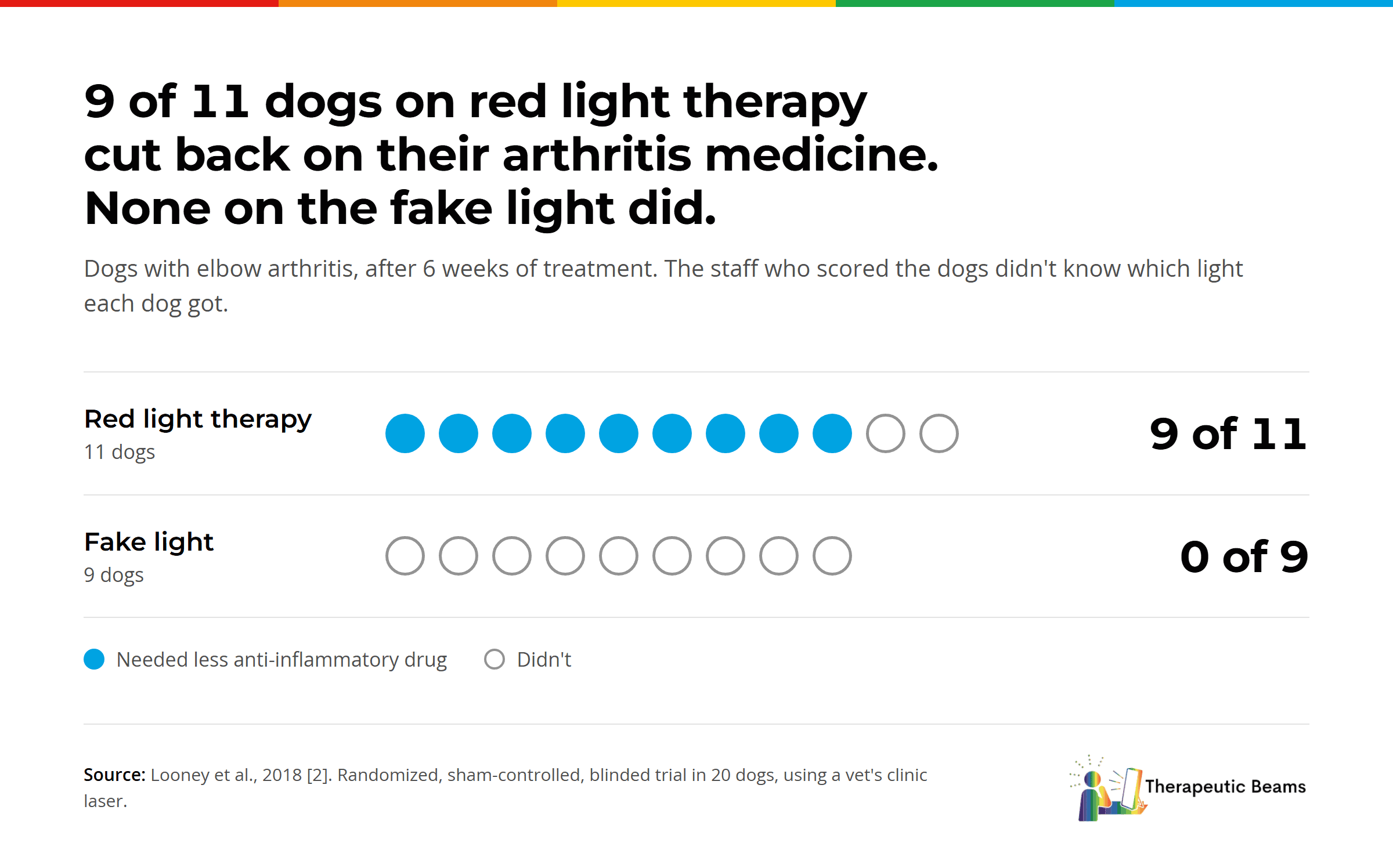
- The best evidence is for dogs with arthritis. In one trial with a fake-light comparison, 9 of 11 treated dogs cut their arthritis medicine and none of the 9 comparison dogs did [2].
- Dogs after surgery and dogs with wounds? The results conflict. Several trials with a fake-light comparison found no difference [5, 6, 9].
- Cats have the thinnest evidence, with three very different studies [12, 13, 14].
- Ask your vet first, since a limp or a sore that won’t heal can have causes red light can’t fix.
- The research is early but promising, and no home device has been tested yet.
Red Light Therapy For Dogs
Dogs have the most research of any animal. For a more in-depth review, read our article on red light therapy for dogs.
Arthritis
Arthritis is where red light therapy has the most support in dogs. A 2018 randomized, sham-controlled trial split 20 dogs with elbow arthritis into real red light therapy or a sham [2]. Randomized means a random draw picked each dog’s group, so the researchers couldn’t stack the deck. A sham is a fake light that looks the same but gives no dose. The staff who scored the dogs didn’t know who got which, which is called blinding. After 6 weeks, 9 of 11 treated dogs needed less of their anti-inflammatory drug. None of the 9 sham dogs did. Treated dogs also had better limping and pain scores.
A second trial studied 20 dogs with arthritis in both hips, 40 hips in all [3]. One group got 3 weeks of treatment with a Class IV laser, the strongest class of therapy laser, used in clinics. The comparison group got 21 days of meloxicam, a common dog anti-inflammatory drug. The laser group scored better on pain and daily function at several check-ins up to 30 days.
After Surgery
Red light therapy results after surgery are mixed. In a 2012 trial, 36 dogs had surgery for a herniated spinal disc. Treated dogs walked sooner than untreated dogs, after a typical 3.5 days versus 14 [4]. That looks promising, but here’s where it gets murky. The dogs were assigned by alternating order instead of a random draw. A 2017 trial of 32 dogs with the same surgery used a sham for comparison and found no difference in recovery. It reported no side effects linked to treatment [5].
A 2023 trial of 54 dogs recovering from knee ligament surgery also used a sham, a device switched off. It found no significant differences in pain, weight on the leg, or a blood marker of inflammation [6]. Infections at the surgery site appeared only in the sham group, 5 of 30 dogs. That gap wasn’t statistically significant, so chance can’t be ruled out.
Wounds
Wound results after red light therapy are mixed. A 2019 review of animal wound studies found two trials in dogs with fresh wounds. Each used 10 dogs and untreated comparison wounds. Treated wounds healed no differently from untreated ones [7]. A third trial in 7 dogs saw visible differences, such as less discharge, but they weren’t statistically significant. One small trial found surgical scars looked better healed in treated dogs.
Newer trials are split too. In 21 dogs with long-lasting wounds, every dog got a salt-water rinse, and two groups also got red light therapy [8]. By day 15, wounds had shrunk 66% with the rinse alone, versus 77% and 85% with red light therapy. The treated groups led from day 7 to day 13, but by day 15 the gap could have been chance. Each group had only 7 dogs, and there was no fake light. In a 2026 sham-controlled trial of 16 military working dogs with tail wounds, daily treatment for 2 weeks didn’t significantly change wound size [9].

Hair Loss
Red light therapy might help some dogs regrow hair, but the one study is small. It was a pilot study, which is a small first test. It treated 7 dogs with noninflammatory alopecia, or hair loss without skin inflammation [10]. They got a laser with blue, red, and near-infrared light twice a week for up to 2 months. Coat regrowth greatly improved in six of seven dogs.
Now for the catch. There was no sham group. The comparison was an untreated patch on each dog, and only one dog had tissue samples taken after treatment. One common cause, seasonal flank alopecia, often regrows by itself. A 2026 review says evidence from studies that used a fake treatment for comparison is limited [11]. A pilot like this can’t separate the laser from nature.

Red Light Therapy For Cats
Cats have the thinnest evidence. The 2023 review found only one cat study among its 45. But there are three cat studies worth mentioning.
The first was a 2019 trial of 30 cats having spay surgery, randomly split into three groups of 10 [12]. Before anesthesia, one group got laser acupuncture, an infrared laser aimed at two acupuncture points. A second group got electroacupuncture, which uses a small electric current at the same points. The third got no acupuncture. All three groups got the same sedatives and pain medicine first. Over the next 24 hours, the two acupuncture groups needed 1 extra dose of pain medicine each, versus 8 doses in the untreated group. Pain scores didn’t differ between groups. This is laser acupuncture, a different idea from red light on a sore spot.
The second was a 1988 lab experiment on nerves. No cat in pain was treated. Researchers recorded signals from 11 heat-sensing nerve endings in cat tongues [13]. After 1 minute of laser, 60% fired less. After 3 to 10 minutes, all of them did. The authors wrote that laser might ease tongue pain.
The third was a vet procedure for skin cancer, so it isn’t at-home red light therapy. Fifty-five cats with tumors on the surface of the nose got photodynamic therapy [14]. A vet applies a light-activated cream, then shines strong red light on the tumor. There was no comparison group. In 47 cats (85%), the tumor disappeared completely. Of those, 24 (51%) saw it return after a single treatment, typically after 157 days. Vets repeated the treatment in 22 cats. At about three years, 23 of the 51 cats followed (45%) were alive and tumor free. Side effects were mild and short-lived. The cream and the light work together, but a home light can’t do that job unfortunately.

Red Light Therapy For Rabbits & Other Small Pets
None of the studies I found tested pet rabbits. Much of the early research used lab rabbits, rats, and mice with wounds made on purpose. Results were mixed, with faster healing in some studies and none in others [7]. That tells us about biology and says little about treating your pet.
What About Red Light Therapy For Horses?
Horses make up 20 of the 45 studies in that 2023 review [1]. The best results are for back pain and tendon and ligament injuries, where vet-applied lasers eased pain. But a look back at 73 horses with tendon injuries found no advantage over standard care. The two best-controlled wound trials found no effect either. So it’s promising, but not yet proven.

How Does It Work?
Red and near-infrared light are absorbed by mitochondria, the parts of a cell that make energy. Researchers think this leads to more ATP, the molecule cells use as fuel, and less inflammation [15]. That’s mostly lab and animal work, so it’s a possible explanation, not proof it helps your pet.
What Vets Use Vs. What You Can Buy
Home devices may differ from clinic lasers in power and session length.
Red light has to reach the target. A 2020 study measured near-infrared laser light passing through tissue in 24 dogs during spay surgery [16]. With the probe touching the skin, more light got through than with it held away. Still, only about 8 to 9% of the power passed through skin, and under 1% passed through skin plus muscle. The authors judged the laser suited to targets within about 14 millimeters of the surface. The study only measured how much light got through. Deep joints in big dogs may get very little.

How To Try It Safely
See your vet first. Animals can’t tell you what hurts or what’s getting worse. A limp or a sore that won’t heal can hide a fracture, an infection, or a tumor, and red light therapy won’t fix those.
If you already own a red light device, trying it with your vet involved is a reasonable step, though the research is early. If your vet’s on board, ask whether red light therapy could sit alongside the treatment plan. You could agree on a set number of sessions and track one thing you can see, such as limping, stairs, or wound size. Keep giving whatever your vet prescribed.
Unfortunately, I can’t give you a home dose, because I couldn’t find one that’s been tested. Protect your eyes and your pet’s eyes from bright light, never leave an animal shut in with a light, and follow the device’s instructions.
FAQs
Is Red Light Therapy Safe For My Pet?
I couldn’t find a study showing whether home devices are safe for pets, so ask your vet. In the trials, a vet or trained staff gave the treatment. One reported no side effects linked to treatment [5], and the cat cancer study reported only mild, short-lived ones [14].
Can I Use It Every Day?
Ask your vet. The elbow trial ran for 6 weeks and the hip trial for 3 weeks, both in a clinic. I couldn’t find a study of daily home use.
Are Some Animals Better Left Untreated?
Possibly, and studies haven’t tested every species. Tell your vet about every medicine your animal takes, because some make skin more sensitive to light. Also mention any skin condition or light sensitivity.

Final Thoughts
The best evidence is for arthritic dogs treated by a vet, and even there the studies are small. For wounds, surgery recovery, and cats, the research is mixed or thin. Thin research isn’t proof that it fails, and the arthritis results are promising. If you already own a red light device, it’s reasonable to try it, but start with your vet. That’s what I told my mother. Red light therapy might help alongside the usual care, but it isn’t a guaranteed fix. I’ll update this article as new studies come out.
References
- https://www.ncbi.nlm.nih.gov/pmc/articles/PMC9951699/
- https://www.ncbi.nlm.nih.gov/pmc/articles/PMC6091142/
- https://pubmed.ncbi.nlm.nih.gov/35895799/
- https://pubmed.ncbi.nlm.nih.gov/22783835/
- https://pubmed.ncbi.nlm.nih.gov/28140641/
- https://pubmed.ncbi.nlm.nih.gov/38039628/
- https://www.ncbi.nlm.nih.gov/pmc/articles/PMC6699315/
- https://www.ncbi.nlm.nih.gov/pmc/articles/PMC8448658/
- https://pubmed.ncbi.nlm.nih.gov/42624280/
- https://pubmed.ncbi.nlm.nih.gov/25227429/
- https://pubmed.ncbi.nlm.nih.gov/42722190/
- https://www.ncbi.nlm.nih.gov/pmc/articles/PMC6541842/
- https://pubmed.ncbi.nlm.nih.gov/3245796/
- https://pubmed.ncbi.nlm.nih.gov/18798792/
- https://www.ncbi.nlm.nih.gov/pmc/articles/PMC5523874/
- https://www.ncbi.nlm.nih.gov/pmc/articles/PMC7429387/

