
A friend I’ve known since college asked me last spring whether her part was getting wider.
It was. She had noticed it about a year earlier and had been parting her hair on the other side to hide it.
She wanted a device recommendation for hair growth, and I gave her one straight away. I told her to buy the iRestore, because it had the most lasers of anything I had tested and the company advertised a 43% increase in hair count.
Then she asked me to send her the study.
I couldn’t find one. Not a paywalled one, not an abstract, not a conference poster. I spent an evening looking and came up with nothing but the number itself, repeated across a dozen websites including my own.
So I went back and read the actual literature on every device I had recommended. This article is the result, and it reaches a different conclusion than the version I published before it.
Here’s the summary.
Best Overall Pick – HairMax PowerFlex 272 Laser Cap
Best Value For Money – HairMax Ultima 12 LaserComb
Best For Speed – HairMax LaserBand 82
Best LED Option – CurrentBody Skin LED Hair Regrowth Device
No Longer Recommended – iRestore Professional (Previously My Top Pick)
Why I Changed My Recommendation
I used to recommend iRestore. I no longer do, and the reason is narrow and specific: I can’t find a published trial of any iRestore device.
That’s not the same as saying it doesn’t work. Low level laser therapy for pattern hair loss is a real, well studied treatment, and iRestore is FDA cleared through the same pathway as its competitors. If you already own one and you are seeing results, keep using it.
But when I searched the medical literature for iRestore, I got nothing. When I searched for HairMax, I got nine papers, including four randomized, sham-controlled trials with 269 people enrolled [1].
That gap matters more than laser count, and it matters a lot more than I gave it credit for when I wrote the first version of this article.
A 2017 meta-analysis in the Journal of the American Academy of Dermatology put it starkly: minoxidil, finasteride, and the HairMax LaserComb are the only treatments for pattern hair loss that the FDA recognizes [2]. Not the only devices that are cleared, which is a low bar many products clear. The only ones the agency recognizes as treatments.
The 5 Best Red Light Therapy Devices For Hair Growth
Three of the five below are HairMax. That’s not a coincidence or a sponsorship, it’s a consequence of the sourcing rule I applied: I ranked devices by whether their manufacturer has published sham-controlled trials, and HairMax is the only brand in this category that has.
HairMax PowerFlex 272 – Best Overall Pick
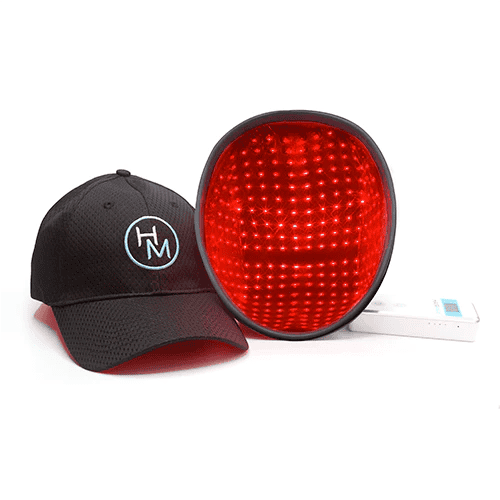
HairMax PowerFlex Laser Cap 272
Premium Option For People Who Want The Least Effort
The HairMax PowerFlex Laser Cap 272 is the one I'd buy if the budget allowed, because it asks the least of you: seven minutes, three times a week, hands-free, under a cap that looks like a cap.
It holds 272 laser diodes at 655 nm, runs off a removable battery pack, and covers the whole scalp at once.
One point of honesty, since it's the whole reason iRestore lost its spot. The HairMax trials I keep citing were run on the company's combs, not on this cap. Same wavelength, same company, same regulatory clearance, but the cap itself hasn't been through a published sham-controlled trial. I'm recommending it on the strength of the brand's evidence and the fact that it's the easiest device here to actually stick with. That's a weaker claim than "this exact product was proven", and I'd rather say so than hide it.
If you’re looking for a slightly more affordable option, check out the PowerFlex Laser Cap 202. It’s exactly the same as the PowerFlex Laser Cap 272. But, as you’ve guessed, it comes with 202 medical-grade lasers.
Read our HairMax PowerFlex Laser Cap 272 review.
- Shortest hands-free session here at seven minutes, three times a week
- Looks like an ordinary cap, so you can wear it around the house or out
- 272 laser diodes at 655 nm, the wavelength every successful trial used
- Cordless, with a removable battery pack you charge between sessions
- Made by the only brand in this category with published sham-controlled trials
- Costs several times what the better-evidenced comb below does
- The published trials were run on HairMax combs, not on this cap
- Won't work without the battery pack attached
HairMax Ultima 12 LaserComb – Best Value For Money

If the evidence behind a device matters more to you than how convenient it is, this is the one to look at. The HairMax Ultima 12 LaserComb is, as far as I can tell, the best-evidenced consumer hair device in existence.
That's not marketing language. The 2014 trial program tested 7-beam, 9-beam and 12-beam lasercombs against sham combs across four separate randomized studies. Terminal hair density rose between 18.4 and 25.7 hairs per square centimeter in the treated groups, against 1.6 to 9.4 in the sham groups [1]. The study was supported by the National Institutes of Health rather than paid for by the manufacturer.
The 12-beam comb in that trial is this comb. A separate clinical review recommends the HairMax LaserComb by name as the device to try after minoxidil and finasteride [11], and a real-world study of 32 patients using it in an office setting saw improvement in 28 of them [12].
The catch is that you have to hold it and comb it through your hair for eight minutes, three times a week. It's the least convenient device here and the most proven. That tradeoff is the honest shape of this category.
Learn more here.
- This exact device type was tested in four randomized, sham-controlled trials
- Funded by the National Institutes of Health, not by the manufacturer
- The least expensive device on this list by a wide margin
- Lets you target the temples and part line, where thinning usually shows first
- Lightweight and portable, and a charge lasts around 24 hours
- You have to hold it and comb for eight minutes, three times a week
- The most demanding routine here, so the easiest one to abandon
- The parting teeth can irritate a sensitive scalp
HairMax LaserBand 82 – Best For Speed

A Full Treatment In Less Time Than Brushing Your Teeth
The HairMax LaserBand 82 is the fastest device here by a distance: 90 seconds, three times a week.
It's a flexible band with teeth that part your hair so the 82 lasers reach the scalp directly rather than shining onto the hair itself. You move it through three positions, 30 seconds each.
Ninety seconds is short enough that the usual reason these devices fail, which is that people stop using them, mostly goes away. Given that the meta-analysis found lower treatment frequency outperformed higher frequency [5], a short session three times a week isn't a compromise.
Learn more here.
- 90-second sessions, the shortest routine of any device here
- Teeth part your hair so the light actually reaches your scalp
- Covers the whole scalp in three passes without committing to a full helmet
- Comes with a charging dock
- Same brand and wavelength as the devices in the published trials
- Treats one section at a time rather than the whole scalp at once
- The parting teeth can be uncomfortable on a sensitive scalp
- The comb has the stronger evidence behind it
CurrentBody Skin LED Hair Regrowth Device – Best LED Option
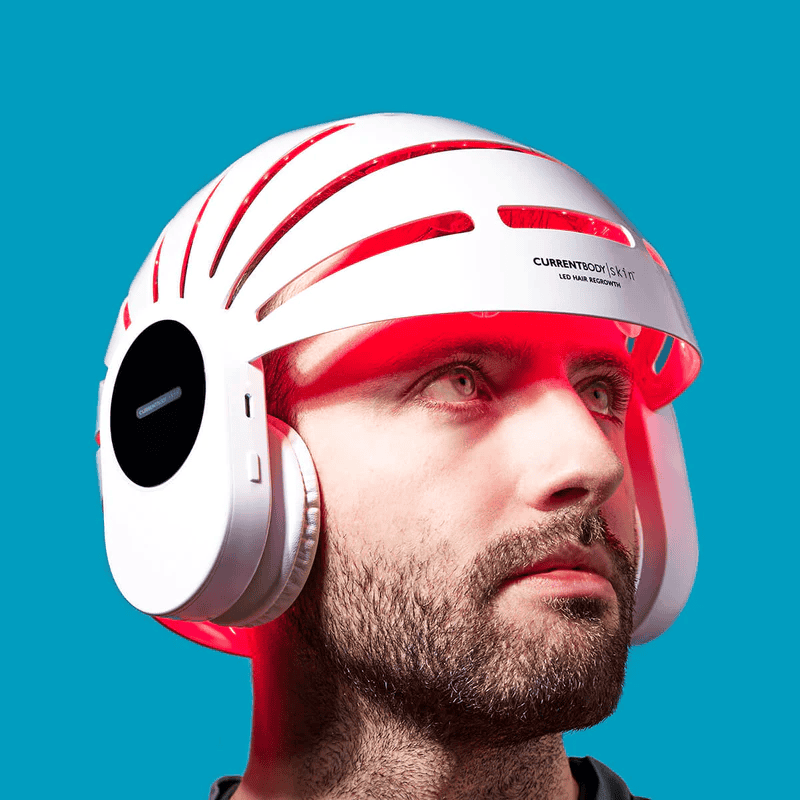
CurrentBody Skin LED Hair Regrowth Device
For People Who'd Rather Build A Daily Habit Than A Weekly One
The CurrentBody Skin LED Hair Regrowth Device uses LEDs rather than lasers, across 630, 650 and 655 nm, in a helmet with built-in Bluetooth headphones. Ten minutes daily.
LEDs spread light over a wider area at lower intensity than lasers. The trials in this article used both types, and the 2019 meta-analysis found no clear winner between device formats [5]. So the format is defensible.
What it doesn't have is a published trial of this specific device. I include it because the wavelengths are right and the daily-use design suits people who want a fixed habit rather than a three-day-a-week one.
Plus, enjoy 15% off the CurrentBody Skin LED Hair Regrowth Device when you use code BEAMSHAIR!
- Uses three wavelengths that all sit in the range the trials tested
- Ten minutes with an automatic shutoff, so you can set it and forget it
- Built-in Bluetooth headphones, which makes the session easier to sit through
- Two sizes, so the fit is better than a one-size helmet
- A daily rhythm is easier for some people to keep than a three-day-a-week one
- No published trial of this specific device
- Requires daily use rather than three sessions a week
- Bulky, so it isn't something you'd wear outside the house
iRestore Professional – No Longer Recommended

What Changed, And Why It's No Longer The One I Recommend
I recommended the iRestore Elite as my top pick in the earlier version of this article, on the strength of its 500 diodes and an advertised 43% increase in hair count over four months.
I've moved it to the bottom of this list because I couldn't verify that number. It appears on the company's own materials and in coverage repeating them, without a sample size, a journal, or a link to the study. I searched the medical literature for any published trial of any iRestore device and found none.
To be fair to the product: it's FDA cleared, it uses the right wavelength, it comes with the most generous money-back guarantee here, and the category it belongs to works. Nothing I found suggests it's unsafe or ineffective. If you own one, this isn't a reason to stop.
But when another brand in the same category has four published sham-controlled trials, and this one has none that I can find, I can't justify pointing readers toward it anymore. That's a change in what I know, not a change in the product.
Read our iRestore Elite review.
- A 12-month money-back guarantee, the longest of any device here
- FDA cleared, through the same pathway as the devices I do recommend
- Uses 650 nm, which is squarely in the range the trials tested
- Full-helmet coverage with a comfortable, ventilated design
- No published trial of any iRestore device that I could find
- The advertised 43% figure comes with no sample size, journal, or citation
- The 500-diode headline is a marketing number, not a measure of delivered energy
- Requires daily sessions, and the battery pack is sold separately
Does Red Light Therapy Work For Hair Loss?
Yes, for thinning hair, and about as well as minoxidil.
That last part is the piece most articles leave out, so let me start there. A 2024 randomized trial compared six months of light therapy against 5% minoxidil in 91 men. Both groups improved significantly. Neither beat the other [3].
A 2025 meta-analysis went further and found that adding light therapy on top of minoxidil produced no measurable extra benefit over minoxidil alone [4].
So this is not a miracle, and it’s not an upgrade over the cheap generic treatment. It’s an alternative for people who don’t want to apply a solution to their scalp twice a day forever, or who have tried that and disliked it.

With expectations set, here is what the evidence supports:
- A 2019 meta-analysis pooled 11 double-blind randomized trials and found a significant increase in hair density versus sham devices, in both men and women, with both combs and helmets [5]
- Men using a 655 nm device saw hair counts rise about 35% over sham [6], and a separate trial of the HairMax LaserComb found a significant density increase over a sham comb across 110 men [7]
- Women saw a 37% increase in one 655 nm trial [8] and 51% in another at 650 nm, though that second study was co-written by an employee of the device manufacturer, which is worth knowing [9]
One caveat on the percentages you see quoted everywhere. The 35% and 37% figures come from trials of a research helmet called the TOPHAT655, not from any publicly sold device. They tell you the category works. They don’t tell you a particular product works.
As for how it works, the honest answer is that we have a decent idea and not a complete one. Light at these wavelengths appears to keep follicles in their growth phase longer. When researchers grew human follicles in a dish and shone 650 nm light on them, the treated follicles stayed in the growth phase about two days longer than untreated ones [10]. That’s laboratory work on isolated follicles, not a result on anybody’s head, but it lines up with what the human trials show.

If you want the wider picture, I have written about what red light therapy does elsewhere in the body.
What To Look For Before You Buy
Look at published power output and wavelength, not laser count. Everything else is comfort and convenience.
Manufacturers compete on diode numbers because it is the easiest thing to print on a box. But a device with 500 diodes spread over a helmet is not necessarily delivering more energy to your scalp than one with 41 in a band, and none of the trials found that more diodes produced better results.
What actually matters:
- Wavelength. The trials that worked used 650 to 660 nm. Anything in that band has evidence behind it
- Whether you will use it. The 2019 meta-analysis found that lower treatment frequency worked better than higher frequency [5]. A device you use three times a week beats one you abandon after a month
- Coverage versus targeting. Caps treat the whole scalp. Combs and bands let you work on the temples and part line, which is where thinning usually shows first
- The return window. Results take three to six months. A 90-day guarantee is not long enough to find out
Pregnant or breastfeeding women should skip this, as should anyone with a history of cancer or recent eye surgery. Ask your doctor if you are unsure.
How To Use These Devices
Follow the manufacturer’s schedule, and give it six months before you judge.
The trials that produced results ran 16 to 26 weeks. People who quit at eight weeks because nothing visible had happened would have been counted as failures in every one of those studies, and they’d have been wrong.
Three practical notes:
- Photograph your scalp monthly in the same spot under the same light. Hair change is too slow to notice in a mirror, which is exactly why every trial used photographs rather than asking people how they felt.
- More isn’t better. Doubling sessions doesn’t double results, and the meta-analysis suggests it may do slightly worse [5].
- Light needs to reach skin. Part your hair, or use a device with teeth that does it for you.

Final Thoughts
If the strength of the evidence is what you care about most, the HairMax Ultima 12 comb is the one to pick, and it wants eight minutes, three times a week, for six months.
If you know yourself well enough to know that a manual routine won’t survive month two, the PowerFlex 272 cap asks a great deal less of you. Convenience is a legitimate thing to buy. It’s just worth naming it as the thing you’re buying.
My college friend went with the comb. She started in June, which is far too early for either of us to claim anything, and I’ll update this article when there’s something honest to report.
What I wouldn’t do again is recommend a device because its box has the largest number printed on it.
References
- https://www.ncbi.nlm.nih.gov/pmc/articles/PMC3986893/
- https://pubmed.ncbi.nlm.nih.gov/28396101/
- https://www.ncbi.nlm.nih.gov/pmc/articles/PMC12278395/
- https://pubmed.ncbi.nlm.nih.gov/39828269/
- https://pubmed.ncbi.nlm.nih.gov/30706177/
- https://pubmed.ncbi.nlm.nih.gov/24078483/
- https://pubmed.ncbi.nlm.nih.gov/19366270/
- https://www.ncbi.nlm.nih.gov/pmc/articles/PMC4265291/
- https://pubmed.ncbi.nlm.nih.gov/28328705/
- https://www.ncbi.nlm.nih.gov/pmc/articles/PMC8577899/
- https://pubmed.ncbi.nlm.nih.gov/24170634/
- https://www.ncbi.nlm.nih.gov/pmc/articles/PMC4154149/

