
Can red light therapy help your migraines?
According to the evidence available today, probably not. There are four small randomized trials, and the researchers who reviewed them graded the certainty as very low. They concluded that the evidence doesn’t support using red light therapy for headaches [1].
I’ve used red light therapy since college, mostly on my skin, and I’d love to tell you it works for migraines too. But there’s something here more useful than a yes or a no. Red light behaves in two completely different ways depending on whether it lands on your skin or reaches your eyes. For migraines, that difference decides whether light helps you or hurts you.
If your migraines come with a tight jaw or neck, there’s a case for trying near-infrared there. If light triggers your attacks, red light is a risk. And if you already own a panel, your real question isn’t which one to buy: it’s whether that panel can even do what the studies did. I’ll get to all three.
Key Learnings
- The four randomized trials are small, most didn’t hide who got the real treatment, and reviewers graded the evidence as very low certainty [1]
- Red light entering your eyes makes an active migraine worse. Green light eases it [5]
- Red light on your skin is a separate question, and there it may reduce muscle pain [6]
- Every trial used a clinic laser aimed at set points on the face and jaw, not a panel at home
- Eye protection isn’t optional for this one. It’s the whole safety story
Can Red Light Therapy Help Treat Migraines?
The honest answer is that nobody has shown red light therapy to be effective for migraines. The studies we have are too small to settle it either way.
In 2022, a team pulled together every randomized trial on photobiomodulation, the technical name for red light therapy, in people with primary headache. That means the headache is the condition itself rather than a symptom of something else, so migraines and tension headaches both count. They found just four, ranging from 36 to 60 participants each: small studies, none big enough to settle much on its own. Most carried a high risk of bias, meaning the way they were run left room for the results to be skewed, and three never described how they sorted patients into groups. The reviewers graded the certainty as very low for every outcome and concluded that the current evidence doesn’t support red light for reducing headache pain or frequency [1].
That’s the bottom line. The individual studies fill in why it stays unsettled.
A 2018 Brazilian trial split 36 chronic migraine patients between low-level laser therapy and botulinum toxin A, better known as Botox. Both groups had fewer headache days, less intense pain, and less medication use. The catch is that there was no placebo group, so we can’t tell how much came from the light and how much from being treated at all [2].
The strongest result arrived in 2024. Researchers in Taiwan recruited 60 chronic migraine patients whose medication wasn’t working well. Half received laser acupuncture at 810 nanometers (nm), which uses a low-power laser on acupuncture points instead of needles. Half got a sham version, meaning the same routine with the laser switched off. Each group had eight sessions across four weeks. By week 12, the laser group had 7.3 fewer migraine days a month, against 1.8 in the sham group [3]. For someone losing ten days a month, cutting seven of them is the difference between migraines running the month and barely noticing them. It’s also a small first-pass study, and the practitioners delivering it knew which patients got the working laser.
You’ll also see a small 2015 study cited a lot in articles like this one. Ten patients, no control group, and tension-type headache linked to jaw problems rather than migraines. It reported a 64% drop in pain scores, but it also found the laser decreased blood flow in the temporal artery, the opposite of the “boosts circulation” claim usually attached to it [4].
How Does It Work?
Red light works through two entirely separate routes, and mixing them up is how most articles on this topic go wrong.
Light Through Your Eyes
In 2016, researchers at Harvard tested five colors of light on migraine patients during an attack. Green light eased the headache. Blue, amber, and red all made it worse; white landed in between. Using recordings from the retina and the visual part of the brain, the team traced the effect to the color-sensing cells in the eye. Those cells feed a relay station deep in the brain that also handles pain. That’s why color matters when your head already hurts [5].
Red light reaching your eyes during a migraine works against you. If you’re reading this mid-attack, here’s the answer for right now: sit in a dark room, and don’t point a red panel at your face. Nothing here treats an active migraine attack.
Light On Your Skin
Shine that same red light on skin, and something different happens. A 2021 review in The Journal of Pain lays the two routes side by side. Red light at 660 nm applied to the skin reduces pain in conditions involving nerve damage. The same wavelength delivered to the eyes makes migraines worse. The two routes even run on different timescales. Skin exposure works over minutes, visual exposure over hours [6].

On skin, that same red and near-infrared light is absorbed by an enzyme in your cells’ mitochondria. This nudges up energy production and lowers inflammation in irritated tissue… but only up to a point – since past a certain dose the effect reverses [7]. More light isn’t always better.
Does any of that translate into migraine relief? Nobody has shown that it does. What we do have is evidence one rung down. A 2023 randomized trial gave 660 nm red LED, an 810 nm laser, or a switched-off dummy device to 60 people with jaw muscle pain. Both active treatments beat the dummy on pain scores. Red LED didn’t significantly reduce the number of tender trigger points, though the laser did [8]. Every participant was a dental student with mild jaw pain, and none had migraines. The trial tells you red light can calm an irritated muscle, but it doesn’t tell you it can stop a migraine.
How To Use It
If you want to try it anyway, use the numbers from the trials rather than the marketing on the box.
Choose near-infrared over deep red
The headache studies used near-infrared wavelengths from about 808 to 904 nm. The 2022 review describes the useful therapeutic window as 660 to 905 nm, because those wavelengths reach past the skin into deeper tissue [1]. Longer wavelengths go deeper.
One 2026 trial tested wavelength head-to-head. Researchers in Lahore randomly assigned 150 people to 820 nm, 675 nm, or a mixed-wavelength LED cluster, with physiotherapy for all three groups. The 820 nm arm won on both pain and headache frequency, and the team had registered its methods publicly before starting [9,10].
Two caveats: these patients had neck-driven headaches rather than migraines, and nobody received light on its own. Read it as evidence about wavelength. A device at the shallow red end still has no headache trial behind it.
Treat the muscle, not the skull
The trials targeted tender points on the temporalis and masseter muscles, the ones that sit at your temples and along your jaw [4]. That’s a plausible target if your migraines come with a tight jaw or neck.
Match the dose, and know when you can’t
Across the four trials, energy ranged from 6 to 12 joules per point, exposure ran 33 to 60 seconds per point, and output power sat between 27 and 100 milliwatts [1]. Those figures come from a clinician holding a small probe against one spot at a time. A panel built to light a whole torso can’t concentrate that much energy on one point, and you have no way to work out what yours delivers there. If you want to follow the trials, the format that matches them is a small handheld device, not a panel.
Close your eyes and use goggles
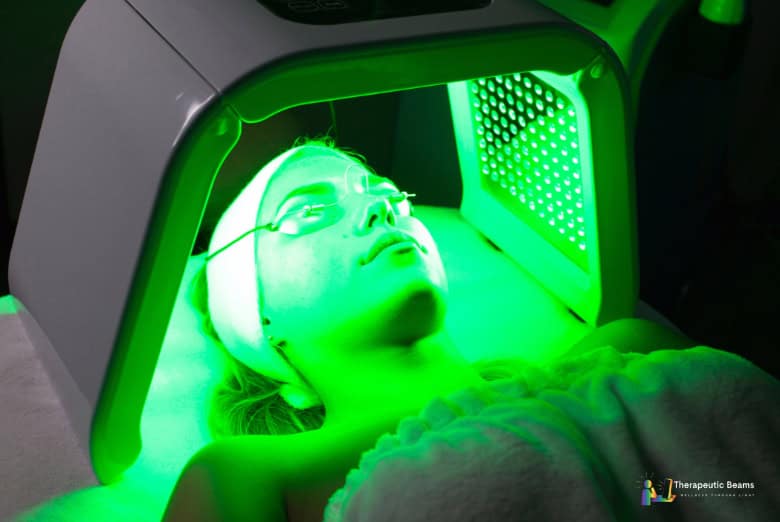
Given what red light does through the retina, eye protection stops being a generic safety line here and becomes the point.
A friend from my gym has had the same red light panel for years, and she texted me mid-attack last spring to ask whether she could just point it at her head. It took me four days of reading before I could give her an actual answer, which tells you the question wasn’t as simple as it sounds. Her panel and the trial devices are different tools doing different jobs. That gap between what gets studied and what people already own comes up every time someone asks me what red light therapy is actually good for.
FAQs
Can You Use Red Light Therapy Alongside Migraine Medication?
Yes, and that’s how it’s been studied. All four trials in the 2022 review tested red light as an add-on rather than a replacement. The 2024 laser acupuncture trial recruited people whose medication wasn’t working well enough alone [3]. Talk to your doctor first, mostly so somebody is tracking whether it’s doing anything for you.
Is Red Light Therapy Safe If You Get Migraines?
The headache trials turned up no serious side effects, though some patients reported a burning sensation at the points where the light was applied [1]. Your risk profile differs from most people’s, though. Red light reaching your eyes worsens an active migraine [5], so eye protection matters more here than it does for someone treating a sore knee. If a session ever seems to bring an attack on, stop and don’t repeat it.
How Many Sessions Did The Trials Use?
The 2024 migraine trial ran eight sessions over four weeks, and its effect kept growing for two months after the sessions stopped [3]. Other trials ran ten sessions across three weeks. Nothing in this literature supports firing up a device mid-attack and expecting relief. These were all preventive courses.
Is Green Light Better Than Red For Migraines?
According to the current evidence, yes. A 2024 review in Current Pain and Headache Reports found green light therapy consistently reduced migraine frequency and severity. Sleep improved, anxiety fell, and side effects stayed minimal [11]. The studies are still small. But if you came here to fix your migraines rather than to buy a red light device, green is where the momentum is.
Final Thoughts
If your migraines come with a locked jaw or a tight neck, near-infrared on those muscles is a reasonable thing to try alongside whatever your doctor has you on. Keep your eyes covered, use a handheld device rather than a panel, and give it twelve weeks before you judge it, since the effect in that 2024 trial kept building for two months after treatment ended.
If you’re shopping for a device specifically to treat migraines, I’d hold off. The red light evidence is four small studies plus one promising early trial, and green light currently has the better case. I’d rather tell you that than sell you a panel.
Have you tried light therapy for your migraines? Tell me what happened in the comments, even if it did nothing.
References
- https://www.ncbi.nlm.nih.gov/pmc/articles/PMC8781567/
- https://pubmed.ncbi.nlm.nih.gov/30427505/
- https://www.ncbi.nlm.nih.gov/pmc/articles/PMC11351446/
- https://pubmed.ncbi.nlm.nih.gov/26202374/
- https://www.ncbi.nlm.nih.gov/pmc/articles/PMC4939697/
- https://www.ncbi.nlm.nih.gov/pmc/articles/PMC8277709/
- https://www.ncbi.nlm.nih.gov/pmc/articles/PMC5523874/
- https://www.ncbi.nlm.nih.gov/pmc/articles/PMC9924200/
- https://revista.domhelder.edu.br/index.php/veredas/article/view/5483
- https://clinicaltrials.gov/study/NCT07163208
- https://pubmed.ncbi.nlm.nih.gov/38865075/

